



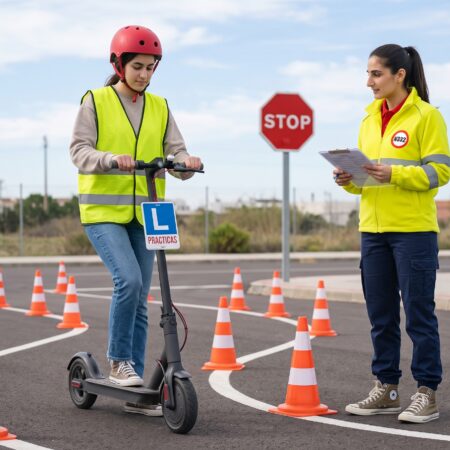
Following the latest report from the Fiscalía General del Estado highlighting escalating drug driving incidents and rising casualties among personal mobility vehicles, Spain’s driving school confederation, CNAE, has called on the Dirección General de Tráfico (DGT) to introduce mandatory training for electric scooter users and preventative awareness modules for new drivers. Writing from the direct perspective of a young road user, Riley argues that punishing teenagers for technical infractions misses the core human failure: young riders are cast onto high-speed roads with zero instruction, balancing on inherently unstable machines while surrounded by fast, aggressive drivers enclosed in protective steel shells.
 Spotify
 Amazon Music
 Apple Podcasts
 YouTube
Have you ever wondered why adults find it so easy to blame young people the second something goes wrong on the road?
You see the headlines constantly. People complain about electric scooters weaving across pavements, riders wearing headphones, or teenagers ignoring priorities at roundabouts. Then come the fines. Then come the public lectures. But stop for a second and think about the question nobody is asking: when did anyone actually teach us how to use these things?
The Confederación Nacional de Autoescuelas (CNAE) has just approached the Dirección General de Tráfico (DGT) with a proposal that should have been obvious years ago. They want mandatory theoretical and practical training for anyone stepping onto an electric scooter, alongside urgent drug and alcohol awareness modules for new drivers. This move comes right after the 2025 report from the Fiscalía General del Estado, which revealed more than sixty thousand administrative cases for drug driving in a single year, alongside a distressing rise in scooter casualties.
When Mark first showed me the report, he immediately focused on the sheer number of infractions. He started analysing statistics, percentages, and urban mobility policy. I told him to look at the human reality instead.
If you hand a fourteen-year-old an electric vehicle that reaches twenty-five kilometres per hour and place them directly onto an active road, what do you honestly expect? An electric scooter is an awkward, twitchy, fundamentally imbalanced machine. It has tiny wheels. A single pothole or uneven drain cover can throw you off balance in half a second. And if you fall, what protects you? A thin strip of polystyrene on your head. If you are lucky.
Now look at who we share that space with.
We are navigating alongside drivers enclosed in two-tonne metal cages, cushioned by airbags, crumple zones, and reinforced doors. When someone inside a car becomes impatient, they press a pedal. They rev their engine. They tailgate. Some honk their horn or cut across our front wheel because they feel our presence is an inconvenience to their commute. The driver is entirely safe inside their fortress. The teenager on the scooter is entirely exposed. One mistake, one momentary loss of balance, or one aggressive manoeuvre from a driver, and the outcome is catastrophic.
Fining someone fifty euros for riding on the sidewalk does not teach them how to negotiate a dangerous crosswalk. It does not teach them how drivers behave in their blind spots. It simply teaches them that the road authority wants their money.
The Fiscalía itself pointed out that preventative education works far better than punitive measures. CNAE is correct. If our society believes that young people should share complex road networks with heavy commercial traffic and fast motorcars, our society has a duty to prepare us for that danger. We need to understand risk perception before we are put in danger, not while a delivery van is overtaking us at fifty kilometres per hour.
There is probably an answer here. We just have to choose education over easy blame.
Other Articles

Watch: Just a Moment
Watch: Never Just Anything