


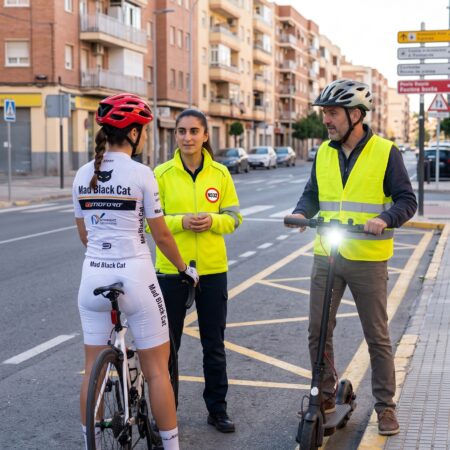
A lot is changing on Spanish roads this autumn. Here is Riley’s quick guide to what you actually need to know.
 Spotify
 Amazon Music
 Apple Podcasts
 YouTube
Okay, so… October is bringing quite a few changes to the rules of the road in Spain.
And before your eyes glaze over at the thought of reading a whole load of legal wording, don’t worry. That is exactly why I am here.
From 1 October 2026, new rules will affect cyclists, electric scooters and other VMPs, motorcyclists, moped riders, drivers, pedestrians and the way traffic moves in certain situations.
The big idea behind the changes is actually quite simple: make the road safer for people.
That includes the people inside cars and vans, of course. But it also means giving more protection to the people who do not have a metal vehicle wrapped around them.
So, if you cycle, ride a scooter, use a motorbike or moped, drive a car, walk to college, ride to work, or basically use Spanish roads in any way at all… some of this is going to matter to you.
Here are the bits I think you really need to know.
If you cycle
There are some important changes for cyclists.
When you overtake a cyclist on an interurban road, you will need to reduce your speed by at least 20 km/h below the applicable speed limit, leave at least 1.5 metres of space and, where there is more than one lane travelling in your direction, move completely into the next lane.
In other words: don’t squeeze past someone on a bicycle just because you think you can fit.
The rules on helmets are also changing. Existing exemptions for cyclists on interurban roads are being removed, so an approved or certified helmet will be required.
And if you are a professional cyclist, the rules go further: helmets and high-visibility clothing will be required in urban areas and on traverses.
There is also a change in how cyclists are expected to position themselves in towns and cities. Rather than hugging the edge of the road simply because there is a car behind them, cyclists will generally be encouraged to ride towards the centre of the lane where that improves visibility and safety.
And if you are driving behind a bicycle in an urban road, you will need to leave at least five metres of safety distance.
Five metres might sound like a lot.
It really isn’t when you think about how quickly things can change on a road.
If you use an electric scooter or VMP
This is a big one for younger riders.
From 1 October, you must be at least 15 years old to ride a VMP.
You will also need to wear an approved or certified protective helmet.
At night, or whenever visibility is significantly reduced, you will need an appropriate luminous or reflective element. And if you are a professional rider, high-visibility clothing is required at all times.
There is another important date to remember, too.
The new requirement for VMP lighting to remain switched on during the daytime does not start in October 2026.
That particular requirement starts on 1 October 2027.
So don’t confuse the two dates.
And remember that the rules about where VMPs can travel remain important too. Motorways, autovías, traverses and interurban roads remain restricted, subject to the specific exceptions provided for cycling infrastructure and certain roads where motor vehicles are prohibited.
The VMP registration and compulsory-insurance framework introduced earlier in 2026 also sits alongside these changes.
So if you ride one, this isn’t just about putting on a helmet and getting going.
You need to know what your vehicle is, where you can use it and what equipment you need.
If you ride a motorcycle or moped
There are some pretty significant changes here as well.
On interurban roads, motorcycle and ciclomotor riders and passengers will have to use protective gloves, although the precise technical requirements for those gloves will come through a later ministerial order.
For now, the transitional rules continue to apply.
Closed footwear is also becoming compulsory for motorcycle and ciclomotor users on all roads.
And yes, that means actual footwear covering the entire foot.
Your favourite open footwear might be comfortable. It is not much protection if your foot meets the road.
There is also a new exception allowing motorcycles to use the right-hand hard shoulder during congestion.
But there are conditions.
It must be a specifically designated and signed stretch, the motorcycle must travel at no more than 30 km/h, riders must travel in single file and they must not endanger other people using the hard shoulder.
That is different from the existing rules for ciclomotores, which retain their own requirement to use the right-hand hard shoulder where it is passable and sufficient.
And if you are a professional rider using a motorcycle, high-visibility clothing will be required at all times.
There is also a transition period for motorcycle helmet homologation. The new homologated UNECE R22 requirement does not take effect until 1 October 2027.
So, again, October 2026 and October 2027 are not the same thing.
If you drive a car, van or other motor vehicle
There are changes for you too.
The previous exemptions allowing certain drivers, including taxi drivers, goods-vehicle drivers and driving instructors, not to wear a seat belt are being removed.
So yes: belt up.
There are also new rules for passing vehicles that have stopped because of an accident, breakdown, assistance, maintenance or traffic regulation.
You must leave at least 1.5 metres of lateral space and reduce your speed by at least 20 km/h below the applicable speed limit.
Then there is the emergency corridor.
If traffic has stopped or is moving at walking pace because of congestion, drivers must position their vehicles to leave a clear central passage for police, emergency services and other authorised vehicles.
It is one of those things that sounds obvious when you hear it.
Until you are sitting in a traffic jam and an emergency vehicle is trying to get through.
Then it suddenly becomes very important.
And if snow makes traffic difficult on a motorway or autovía, overtaking will be prohibited. Traffic must remain in the right-hand lane, leaving the left lane available for emergency and snow-clearing vehicles.
So if the weather turns nasty, don’t assume that the normal rules still apply.
And pedestrians matter too
The changes are not just about vehicles.
The regulations now formally recognise safe school routes, allowing authorities to introduce appropriate signs, markings, speed limits and restrictions to help children travel safely to school on foot, by public transport or using non-motorised forms of mobility.
Pedestrians, children, older people, people with reduced mobility, cyclists, VMP users and motorcycle and ciclomotor users are also formally recognised within the regulations as vulnerable road users.
I actually think that is quite important.
Because being a “vulnerable road user” is not about being a better or worse person.
It is about what happens when things go wrong.
A pedestrian does not have a bonnet.
A cyclist does not have an airbag.
A scooter rider does not have a seat belt.
A motorcyclist does not have a car’s structure around them.
That difference matters.
And then there are the transition periods
This is the bit I really want you to remember.
Not every change starts on 1 October 2026.
1 October 2026
Most of the new rules begin.
That includes the new VMP age limit and helmet requirement, the motorcycle and moped clothing requirements, the new overtaking rules, emergency corridors, changes to seat-belt exemptions and the other provisions covered in this guide.
1 October 2027
Two important requirements have a one-year transition:
VMP daytime lighting — the requirement to have the lights permanently switched on during the day begins on 1 October 2027.
Motorcycle helmet homologation — the new homologated helmet requirement also begins on 1 October 2027.
Gloves
The new technical requirements for protective motorcycle and ciclomotor gloves will apply when the relevant ministerial order comes into force.
Until then, the transitional provision allows the protective gloves currently used to continue.
Ciclomotor helmets
There is also a one-year transition for ciclomotor users to move from currently certified helmets to the new homologated standard.
So, if you ride, don’t panic-buy everything on 30 September.
But don’t ignore the changes either.
So what is the big picture?
For me, the most important part of all this isn’t actually one individual rule.
It is the direction of travel.
Spanish road regulations are increasingly recognising that roads are shared spaces.
Cars matter.
But so do bicycles.
So do scooters.
So do motorbikes.
So do pedestrians.
And sometimes the safest thing you can do is simply give another person a little more room, a little more time and a little more attention.
You don’t have to agree with every rule to understand the reason behind it.
And when you are the person on the other side of the bonnet, that extra space might be the thing that makes the difference.
If you want the full legal detail, including the specific legislation and official references, you can find the complete N332 guide alongside this article.
For now, though, remember the date:
1 October 2026.
New rules.
New responsibilities.
Same roads.
Let’s use them safely.
— Riley xxx
Listen to my Podcast in English or Spanish
October is bringing some big changes to road safety in Spain — and if you cycle, ride a scooter, use a motorbike or moped, drive a car, or simply walk around town, some of them could affect you.
In this episode, I break down the changes coming from 1 October 2026, including helmets, protective clothing, overtaking cyclists, emergency corridors, VMP rules, seat belts and more.
And there is one important thing to remember…
Not everything starts on 1 October 2026.
Este octubre llegan importantes cambios en la seguridad vial en España. Y si vas en bicicleta, utilizas un patinete, conduces una moto o un ciclomotor, conduces un coche o simplemente caminas por la ciudad, algunos de ellos pueden afectarte.
En este episodio te cuento, de forma sencilla, qué cambia a partir del 1 de octubre de 2026: cascos, equipamiento de protección, adelantamientos a ciclistas, corredores de emergencia, normas para VMP, cinturones de seguridad y mucho más.
Pero hay algo importante que recordar…
No todo empieza el 1 de octubre de 2026.
Read, Download, and Print your Free Guide in English or Spanish