



One thing I remember from when I was younger is that when rules change, or new rules are introduced, I was often told things like, “you have to, it´s the law!”, or when I asked for an explanation, I was told things like, “just because”, or, “we just have to”, and although I understood that rules are important and must be followed, it always left me wondering why they exist.
So, when I first got involved with N332 and road safety, I asked Mark and Francisco if we could try to make sure that we, at least, answer the questions, to try to give a better understanding of why rules exist, because when it comes to traffic law, every one of those rules is designed for one purpose only, to protect us,
I have been reading about some new road safety rules that Spain plans to introduce soon. Some of them affect people who use bicycles, scooters, motorcycles and other forms of transport that do not have the protection of a car around them, including when we walk.
When I first heard about the changes, I wondered what a lot of young people probably wonder, as I did just a few years ago:
Why do we need more rules?
The answer is actually quite simple.
Because people can get hurt.
What Does “Vulnerable Road User” Mean?
One of the biggest changes is that the law now recognises something called a vulnerable road user.
That sounds like a complicated grown-up phrase, but it really means someone who has less protection if something goes wrong.
If you think of an egg, it is better protected in a box than if it is loose.
If you are walking, riding a bicycle, using a scooter or riding a motorcycle, you do not have seat belts, airbags or a metal body around you like a car does.
If a crash happens, you are much more likely to be injured.
That does not mean you should be frightened. It just means we need to understand the risks and make sensible choices.
Rules Help, But They Are Not Magic
One thing I think is really important is that rules do not automatically keep people safe.
A speed limit sign cannot stop someone from being distracted.
A helmet cannot stop a collision from happening.
A pedestrian crossing cannot make somebody pay attention.
The rules help create safer conditions, but people still have to make good decisions.
Drivers must stay alert.
Cyclists must stay alert.
Scooter riders must stay alert.
Pedestrians must stay alert.
Road safety is a team effort.
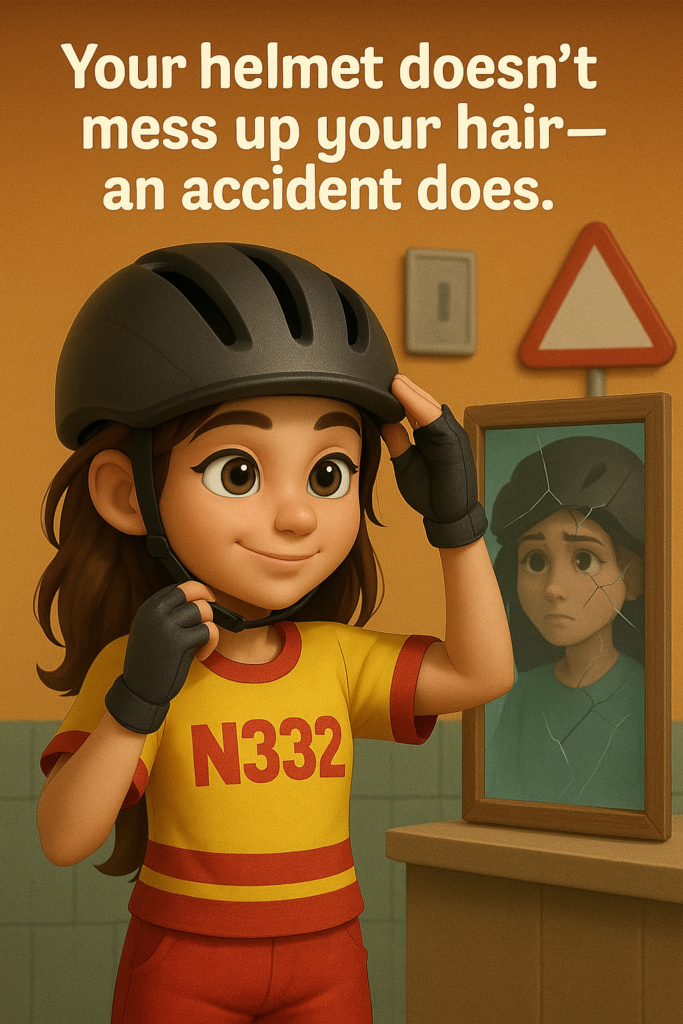
The Helmet Isn’t Just for Show
One of the changes that many young people will notice is the focus on helmets.
Some people see a helmet as something they wear because an adult tells them to.
But a helmet has a very specific job.
It is designed to protect your head if you fall or are involved in a collision.
That protection only works if the helmet is worn properly.
A helmet balanced on top of your head is not much use.
A helmet with the straps hanging loose is not much use.
A helmet hanging from the handlebars is not much use.
A helmet that is too big can move when you need it most.
The straps are not there to annoy you. They are there to keep the helmet in the correct position, which is really important during an impact.
Think about it this way: if a helmet flies off before your head reaches the ground, it cannot do its job.
Looking and Thinking
Most collisions do not happen because somebody woke up in the morning intending to cause one.
They happen because somebody did not see something.
Or did not notice something.
Or looked but did not really process what they were seeing.
That is why awareness is so important.
When I am walking, cycling or using my scooter, and when I am driving now, I try to ask myself:
- What is happening around me?
- What could happen next?
- Has that driver seen me?
- Is there anything hidden by a parked vehicle?
- Am I paying attention?
Those few seconds of thinking can make a huge difference.
Being Right Isn’t Enough
One of the most important road safety lessons I have learned is that being right is not enough.
You might have priority.
You might be following all the rules.
You might be exactly where you are supposed to be.
But if somebody else makes a mistake, you can still get hurt.
That is why I always try to think about safety before priority.
I would rather arrive safely than prove I was right.
Looking After Each Other
The new rules are designed to help protect people who are most at risk on our roads.
That is a good thing.
But the most important safety equipment we have is not a helmet, a bicycle, a scooter or a set of traffic lights.
It is the ability to pay attention.
If we stay aware, think ahead and look out for one another, we can all help make our roads safer.
And that is something worth remembering, whatever age we are.
Riley’s Road Reminder
A helmet only protects the head that stays inside it. Make sure it fits properly, fasten the straps correctly, and wear it every time.
The New Rules for Bikes and Scooters
Some new road safety rules are coming to Spain, and a few of them affect young people who use bicycles and electric scooters.
Don’t worry – this isn’t a complicated law lesson!
Here are the most important things to know.
1. You Must Be 15 to Use an Electric Scooter
The new rules set a minimum age of 15 for using an electric scooter on public roads.
If you’re younger than 15, you’ll need to wait a little longer before riding one legally on the road.
Your electric scooter must also have a registration plate on the back, and insurance, but a grown-up will have to sort this for you.
2. Wear a Helmet
If you use an electric scooter, you’ll need to wear a helmet.
That’s a good idea anyway.
Your head is one of the most important parts of your body, and a helmet can help protect it if you fall or have a collision.
Riley’s Tip
A helmet only works if:
✓ It fits properly
✓ It sits correctly on your head
✓ The straps are fastened
A loose helmet can come off when you need it most.
3. Switch Your Lights On
Electric scooters will need lights switched on whenever they are being used.
Lights help other people see you.
Remember though, being seen is not the same as being safe.
Always stay alert and watch what is happening around you.
4. Wear Bright Clothing at Night
If you are riding an electric scooter at night or when visibility is poor, you will need reflective clothing.
Reflective clothing helps drivers, cyclists and other road users spot you more easily.
The earlier people see you, the more time they have to react.
You should always wear bright clothing anyway, like I do, and remember to be careful is you are carrying a backpack as it could cause you to wobble, and could hide your bright clothing.
5. Cyclists Need Space
One of the new rules reminds drivers to give cyclists more room when overtaking.
This is because bicycles do not have seat belts, airbags or a metal body around them.
If you ride a bike, remember that drivers should give you space, but always stay aware and never assume every driver has seen you.
6. Ride Where Others Can See You
Cyclists are encouraged to ride where they can be seen clearly.
Sometimes that means riding in the centre of the lane rather than hugging the kerb.
Being visible helps other road users understand where you are and where you are going.
7. Look Out for Each Other
This might be the most important rule of all.
Road safety is not just about laws.
It is about people.
Drivers need to look out for cyclists.
Cyclists need to look out for pedestrians.
Scooter riders need to look out for everyone.
And everyone needs to pay attention.
8. Rules Help – But They Don’t Guarantee Safety
New rules can make roads safer.
Helmets can reduce injuries.
Lights can make you easier to see.
Reflective clothing can improve visibility.
But none of these things are magic.
The best safety tool you have is still your brain.
Stay alert.
Stay aware.
Think ahead.
And never stop paying attention to what is happening around you.
Riley’s Quick Checklist
Before you ride:
✓ Helmet fitted properly
✓ Straps fastened
✓ Lights working
✓ Reflective clothing if needed
✓ Eyes up and paying attention
✓ Ready to look out for others
That’s how smart road users travel safely.
Other Articles

These New Spanish Road Rules Are About Us